Pages

Showing posts with label Wheat. Show all posts

Tuesday, December 13, 2011

My Bread and Butter

My Whole Wheat Bread
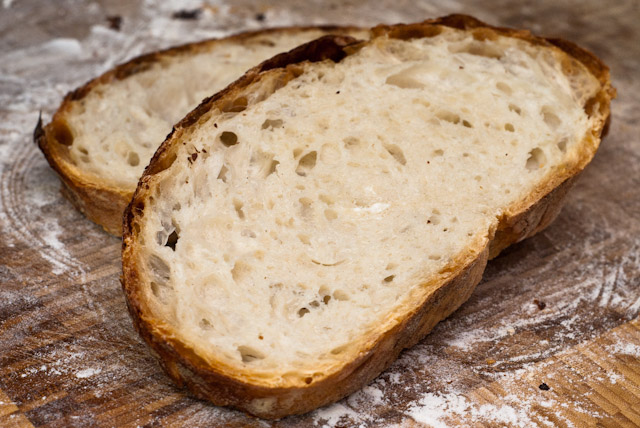
It seems the My Bread post was quite popular. I have been baking a lot of bread since that first loaf. It still blows me away that I can make an artisan bread at home in my 55 year old oven. I have tried a few different breads besides the standard Italian loaf from the original recipe. I've experimented with Olive Bread, Cheese Bread, Olive & Cheese Bread, and even a Pumpkin Yeast Bread. All of those are very good, but the recipe I have perfected is for a whole wheat bread. I started with the wheat bread recipe that was published in Jim Lahey's book "My Bread." However, I felt like his wheat bread recipe wasn't as wheatie as I like. I experimented with several ratios of bread flour and whole wheat flour until I got close to what I was looking for. Then, I could taste what was missing. In my recipe there is a small amount of rye flour. The rye gives the bread just a little bit of that tangy rye flavor. I really think it makes a wonderful whole wheat bread.

Homemade Butter Ball
When it comes to the standard Italian bread I like the bread by it self or with a really nice high quality olive oil. However, with wheat I tend to go for butter. Last night I was baking a loaf of my whole wheat bread for a potluck at work. I was thinking about going to the store to get my favorite brand of butter. I couldn't tell you what the brand name is, all I know is it is imported from Italy and it comes wrapped in wax paper with blue lettering and is riveted closed on both ends with brass rivets. The butter is quite different from your every day butter found in most grocery stores. This butter is slightly sweet and has a flavor closer to fresh cream than what I usually think of as butter. The trouble is I only know one place to get it and I didn't have time to go before the potluck today. My solution was to make my own.

I had never made butter before, but I can tell you it is quite simple and not very much work if you have some kind of machine to agitate the cream for you. I've been told that butter making is a great activity for kids. You give them a jar with cream inside and have them shake until it becomes butter. I can't wait to have kids some day. This should keep them occupied before meals. Anyways, I made my butter in my stand mixer, but you could also use a food processor or blender.

I think the key to making good butter since there isn't any real technique involved is to start with good cream. I used the best cream I could find at Trader Joe's since TJ's is only a short walk from my home, but I know that isn't the best cream available. The organic heavy whipping cream at TJ's is fine and it made a pretty good butter, but it is ultra pasteurized, something you should avoid if possible. Around the Bay Area and certainly in the East Bay we have a remarkable dairy, the Straus Family Creamery. The Straus Family Creamery's products are available in most better grocery stores. If it is convenient then by all means use their products, especially if you are going to go through the trouble of making your own butter. I will next time. Heavy whipping cream is all you are likely to find in the stores, but the best cream to make butter with would be manufacturing cream. Manufacturing cream has a butterfat content of 40% or more where heavy whipping cream is between 35% and 40%. It is really difficult to find manufacturing cream in the stores since the restaurants buy it all. If you find manufacturing cream please, please, please let me know where you got it!

Whole Wheat Bread and Home Made Butter Recipes follow

Saturday, October 29, 2011

My Bread


I was recently in New York City taking a badly needed and well deserved holiday. I stayed with a friend of mine from high school. When I arrived at his apartment in Brooklyn he had a loaf of the most wonderful home made bread. He has been telling me for a few years now about the no-knead bread method pioneered by Jim Lahey of the Sullivan Street Bakery in Manhattan. Jim's method became wildly popular with food lovers after it appeared in Mark Bittman's column The Minimalist. Jim's method really does allow a home baker to produce a loaf of bread that is every bit as good, if not better, than the artisan bread bakerys here in the Bay Area.

While I was in New York I decided to visit the Sullivan Street Bakery. I tried the Pizza Puttanesca and a half piece of the Artichoke Strecci. I wasn't wild about the puttanesca sauce on the pizza. In my opinion the fishy flavor from the anchovies overpowered the flavors of the bread and was a little too prominent for a sauce that is so liberally applied to the thin crisp crust. The strecci was bliss. Artichoke hearts and garlic baked in an Italian baguette. Perfect!
While I was eating at the bakery I discovered that Jim wrote a book about his no-kneed bread method called "My Bread: The Revolutionary No-Work, No-Knead Method."  I have to say I was a little skeptical about the idea that one could produce a bread that was anything close to what comes out of commercial steam ovens, but baked in a home oven. After tasting my friends bread and the bread baked at the bakery from whence this method came I bought the book.
 

This was my first attempt at baking a yeast bread, save for pizza dough. Jim suggests in his book that you start with the basic recipe before trying some of the more extravagant recipes in his book.

I won't go into great detail on the method as it is pretty well covered by Mark Bittman in his column. The recipe can be found here.
Basically you mix the flour, salt, yeast, and water into a very sticky wet dough. The dough isn't worked or kneaded and looks pretty messy at first. The dough is allowed to rise for 12 to 18 hours during which the gluten in the flour is developed slowly. The long rise also allows naturally occurring bacteria and fermentation to bring much more flavor to this basic bread than found in a quick rise bread.
Once the dough has risen it is placed into a heavy pot or dutch oven with a tight fitting lid, preferably made of clay or cast iron. The bread is baked in the pot in a hot oven with the lid on for the first 30 minutes of baking. Since the dough is relatively wet baking it with the lid on mimics a commercial steam oven. After 30 minutes the lid is removed and the bread is allowed to bake for 10-30 minutes longer. This allows the crust of the bread to caramelize and become, well, crusty. If you make this bread do yourself a favor and allow the crust to become really dark, but not burned. It will add a wonderful texture and really add to the flavor of the bread.

I can honestly say that the loaf I made this morning is the best bread I have ever tasted.


Notes
I baked my bread in an oven that was somewhere between 475º F and 500º F. I made a mistake and put the bread in the pot with the seam side down, but I rather like how that turned out, so I may continue to bake the bread this way. I believe that it made the bread rise a little higher at the expense of a wider loaf. I used flour for dusting the dough.

Enjoy!