Showing posts with label Bread. Show all posts
Sunday, September 30, 2012
Bumper Crop 1: Zucchini Bread
What do you do with a bunch of giant zucchini's from the garden? I've found a few good uses for the abundance of zucchini that came from my garden last year. These summer squash (I know this is a little late) can grow from a perfectly usable size to something bearing more resemblance to a skinny watermelon in a blink. Often the larger zucchini lack a little in flavor, so I'm not advocating that you grow them so large. If you truly want the best flavor harvest them when they are between 5 and 6 inches long. Zucchini bread is probably my favorite use for the larger zucchini you'll end up with if you aren't paying attention.
Zucchini bread is really a cake. It is quite sweet and I find it rather addictive. Make sure you have someone to share this with because it is hard to stop eating it once you've sliced off that first piece. I've perfected my recipe for Zucchini bread since last summer. I found a balance of white and brown sugar that seems to work quite well. The best way to show off this bread is to use the best cinnamon you can find. I get mine from here (www.thespicehouse.com). This cinnamon is the sweetest most fragrant cinnamon I have found. Trust me it makes a huge difference in any dish calling for cinnamon.
Recipe for Bradley's Zucchini Bread follows
Monday, February 20, 2012
Artisan Pizza at Home
|
|
| Pizza Funghi | Pizza Trifecta |
What I'm about to share goes against most of what I've read about making artisan pizzas. I'm becoming a really big fan of Jim Lahey and his simple bread dough methods. Several months ago I did a post (two actually) on Jim's no-knead bread recipe. The recipe blew my mind the first time I tried it and turned out a loaf that was every bit as good as the loaves from artisan bakeries. The recipe came from My Bread: The Revolutionary No-Work, No-Knead Method by Jim Lahey. The book is proving to be an invaluable resource for bread related recipes. Recently I tried his recipe for Walnut Raisin Bread which was incredible. There are several more I still plan to try. I've been making fresh bread about 4 times a month with consistently delightful results since that first loaf.
A friend of mine wanted to come over and make Pizza for dinner last night. She suggested, since it was already 4:00 PM, that maybe we should buy a pre-made dough from Trader Joe's. I'm all for making delicious food simple and accessible, so that was not a bad suggestion. But, I remembered that Jim Lahey had a pretty interesting looking recipe for pizza and it didn't require a lot of time or work. I looked up the recipe and in less than 10 minutes I had assembled the dough. Two hours more would be required for the first rise and 30 minutes for the second rise. This would put the cooking time at 6:45 PM. Perfect!
What's the secret to homemade artisan style pizza? You don't need a pizza stone, balance and quality of ingredients, and Jim's dough recipe. We made two pizzas. The first a Pizza Funghi (mushroom pizza), the recipe for which basically came from Jim's book substituting shallots for yellow onion. The second pizza was what I'm calling Pizza Trifecta which is a three topping variation of the classic pizza margarita topped* with arugula.
We agreed that these pizzas exceeded our wildest expectations and were better than some wood oven pizzas we've had. It really was artisan pizza at home!
Recipes for Dough, Pizza Funghi (my way), and Pizza Trifecta follow.
Tuesday, December 13, 2011
My Bread and Butter
![]() |
| My Whole Wheat Bread |
![]() |
| Homemade Butter Ball |
I had never made butter before, but I can tell you it is quite simple and not very much work if you have some kind of machine to agitate the cream for you. I've been told that butter making is a great activity for kids. You give them a jar with cream inside and have them shake until it becomes butter. I can't wait to have kids some day. This should keep them occupied before meals. Anyways, I made my butter in my stand mixer, but you could also use a food processor or blender.
I think the key to making good butter since there isn't any real technique involved is to start with good cream. I used the best cream I could find at Trader Joe's since TJ's is only a short walk from my home, but I know that isn't the best cream available. The organic heavy whipping cream at TJ's is fine and it made a pretty good butter, but it is ultra pasteurized, something you should avoid if possible. Around the Bay Area and certainly in the East Bay we have a remarkable dairy, the Straus Family Creamery. The Straus Family Creamery's products are available in most better grocery stores. If it is convenient then by all means use their products, especially if you are going to go through the trouble of making your own butter. I will next time. Heavy whipping cream is all you are likely to find in the stores, but the best cream to make butter with would be manufacturing cream. Manufacturing cream has a butterfat content of 40% or more where heavy whipping cream is between 35% and 40%. It is really difficult to find manufacturing cream in the stores since the restaurants buy it all. If you find manufacturing cream please, please, please let me know where you got it!
Whole Wheat Bread and Home Made Butter Recipes follow
Saturday, October 29, 2011
My Bread
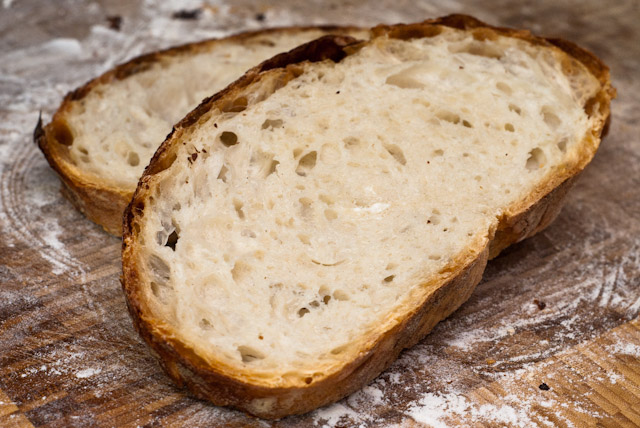
I was recently in New York City taking a badly needed and well deserved holiday. I stayed with a friend of mine from high school. When I arrived at his apartment in Brooklyn he had a loaf of the most wonderful home made bread. He has been telling me for a few years now about the no-knead bread method pioneered by Jim Lahey of the Sullivan Street Bakery in Manhattan. Jim's method became wildly popular with food lovers after it appeared in Mark Bittman's column The Minimalist. Jim's method really does allow a home baker to produce a loaf of bread that is every bit as good, if not better, than the artisan bread bakerys here in the Bay Area.
While I was in New York I decided to visit the Sullivan Street Bakery. I tried the Pizza Puttanesca and a half piece of the Artichoke Strecci. I wasn't wild about the puttanesca sauce on the pizza. In my opinion the fishy flavor from the anchovies overpowered the flavors of the bread and was a little too prominent for a sauce that is so liberally applied to the thin crisp crust. The strecci was bliss. Artichoke hearts and garlic baked in an Italian baguette. Perfect!
While I was eating at the bakery I discovered that Jim wrote a book about his no-kneed bread method called "My Bread: The Revolutionary No-Work, No-Knead Method." I have to say I was a little skeptical about the idea that one could produce a bread that was anything close to what comes out of commercial steam ovens, but baked in a home oven. After tasting my friends bread and the bread baked at the bakery from whence this method came I bought the book.
This was my first attempt at baking a yeast bread, save for pizza dough. Jim suggests in his book that you start with the basic recipe before trying some of the more extravagant recipes in his book.
I won't go into great detail on the method as it is pretty well covered by Mark Bittman in his column. The recipe can be found here.
Basically you mix the flour, salt, yeast, and water into a very sticky wet dough. The dough isn't worked or kneaded and looks pretty messy at first. The dough is allowed to rise for 12 to 18 hours during which the gluten in the flour is developed slowly. The long rise also allows naturally occurring bacteria and fermentation to bring much more flavor to this basic bread than found in a quick rise bread.
Once the dough has risen it is placed into a heavy pot or dutch oven with a tight fitting lid, preferably made of clay or cast iron. The bread is baked in the pot in a hot oven with the lid on for the first 30 minutes of baking. Since the dough is relatively wet baking it with the lid on mimics a commercial steam oven. After 30 minutes the lid is removed and the bread is allowed to bake for 10-30 minutes longer. This allows the crust of the bread to caramelize and become, well, crusty. If you make this bread do yourself a favor and allow the crust to become really dark, but not burned. It will add a wonderful texture and really add to the flavor of the bread.
I can honestly say that the loaf I made this morning is the best bread I have ever tasted.
Notes
I baked my bread in an oven that was somewhere between 475º F and 500º F. I made a mistake and put the bread in the pot with the seam side down, but I rather like how that turned out, so I may continue to bake the bread this way. I believe that it made the bread rise a little higher at the expense of a wider loaf. I used flour for dusting the dough.
Enjoy!
Subscribe to:
Posts (Atom)